Monday, April 19, 2010

Episode 6 Pacific

18 April 1942 Lt. Col. James Doolittle USAAF with 16 B-25 Bombers and 80 Airmen launch from the aircraft carrier USS Hornet and strike Japan.

I asked Jerry if he remembered much about the incident.
"Well it was in the papers about the raid. I was a junior in high school. It was a big deal. Hey the military struck right at the heart of Japan."
On Pacific Jerry agreed water was a problem. He recalled on Saipan that his canteen got hit with shrapnel. When he brought a wounded Marine back to the beach he found a quick remedy for no canteen.
"I grabbed the wounded guys canteen. He didn't need it and I'd put it to good use." Simple shrug of the shoulders.
Guys getting hit.
"Well if a guy got hit several guys would jump up and carry the stretcher. Depending on the size of the guy we'd have two or four guys. There was never a shortage. I and others always felt that if we were hit, someone would take care of us in the same fashion. Plus it got you out of immediate gunfire for a few minutes. I'd try and get a hot cup of coffee and grab as much ammo as I could get, to bring back. We'd drop our packs and ammo belts and grab more at the beach head.'
"The LST's that beached or damaged would be set a up as an aid station. The serious cases would be taken out to the hospital ships."
Chamorro Prisoners at Saipan.
"We took a lot of Chamorro Prisoners. They were natives the island. The Japs had forced them into working for them. Myself and another guy were bringing Chamorro prisoners to a camp and a woman went into labor. The other guy said 'Have you ever birthed an animal?" "Ah gee no, I grew up in the city."
The other Marine said no sweat. He delivered the baby and I helped. I carried the baby back to the POW camp. The mother was in better shape then I was for God's sake. It was an experience watching the baby get born and helping."
The assault on the airfield on Pacific.
"The thing that strikes me the most is the guys bunching up. We were told that you shouldn't ever bunch up. Lot of guys together. One shell could take everyone out, or a machine gun could do alot of damage . But then you had the senior guys saying follow me or stay close."
"I remember one guy in combat running around hollering; ' I can't find my plate I lost my plate.' He had lost the base plate for the mortar. I was always glad I wasn't in the weapons section carrying the parts to the mortar or the machine gun. It was bad enough having to run like hell but to carry all that equipment..." Then that trade mark chuckle.
Jerry said it was a great depiction of combat in the Pacific Theater of Operations. Speilberg and Hanks have captured the moments well. When the Gunny said ' Check your ammo. What do you got and what do you need. Standby to standby." Jerry chuckled.
"Yeah, hey you were glad to have survived. Make a check of your equipment and grab a smoke if you could. You know they filled water in the jerry can. Then they put fuel in them. I think the Navy carted those cans all over the Pacific. God the water tasted like sh#@ from those cans."
Intelligence sources say Jerry was getting a little tired of the soap opera part with the girlfriends and other drama. Lets just say G2 had it on good authority.

Jerry was happy with Episode 6. The depiction of guys getting wounded and getting a corpsman up to treat them. The confusion during combat. Scouting up front and getting shot at. All things that Jerry has experienced first hand. He has that great sense of humor and laughs a lot about the crazy things that happened in combat.

He said that there were alot of guys from the southern states.
"They used to laugh like hell at my accent. They always got me to say; 'I parked my car in Harvard yard.' Those guys would fall over laughing. Saying a spoke funny. " Hey you guys should listen to yourselves. You sound pretty funny to me."

Jerry give tonight's episode high marks.


Stay tuned, G-3 (operations) is planning to have something special cooking for the episode covering the Invasion of Iwo Jima. Get together with some of Jerry's Marine buddies from the Birthday Ball for chow and them watching the show. Should be good!

"There are two kind of people who understand the MARINES. Marines and the enemy. Everyone else has a second hand opinion."
Unknown


Tuesday, April 13, 2010

Jerry and Paul "Frenchy" Lamoureux

When Jerry's wife Rita was dying in November of 1983 Jerry and I spent along time late one night. The conversation drifted to the topic of being a Marine in World War 2. I learned somethings that night. Life lessons from a guy that I never expected to learn them from. I thought he was a simple accountant. Was I ever wrong. Yeah someone slap me in the back of the head now!

We touched on his experience from time to time. The conversations have expanded over the years. I'm still learning.

Back around 2004 his granddaughter, Avery Palardy, was given a project on WW2 by her teacher. The task, was that if you had a relative that had served in WW2 to interview and bring them in to class. The idea was to document and allow the students to learn about WW2.


In conversation one afternoon Jerry was pretty excited about the project and pulled me aside.

"Hey I was at the school and there were three other veterans there. We all started asking about each other. One guy was in the Navy, another in the Army Air corps and another in the Army. The guy in the Army and I started shooting the sh@#( we are g-rated here). I said I was in the Marines and he said he was a paratrooper. Easy Company, 2nd, Battalion 506th, 101st AIRBORNE." I replied " NO SH#%!"


Turns out he was Paul "Frenchy" Lamoureux of North Smithfield, RI. Frenchy was Dick Winters interpreter in Normandy or so the story goes. Frenchy parachuted into Ste Mere Eglise early on 6 June 1944. He was in Lt. Dick Winters "stick" jumping from the same C-47.


For you historians in the audience D-Day 6 June 1944 is always associated with the Invasion of Normandy. However On 15 June 1944 the 2nd MARDIV, 4th MARDIV and the US Army 27th Infantry Division invaded Saipan. The invasion fleet left England on 5 June. On the other side of the world, the invasion fleet was leaving Pearl Harbor for Saipan the same day.

Jerry and Frenchy became pretty fast friends in a short time. Each had become battle hardened in combat and tempered over the years building families and moving forward. Both came from large families. Jerry one of nine and Frenchy from a family of 13.

Jerry and Frenchy came of age in a time when this country was at war all over the world. In the words of a Special Forces NCO that I know; " ...those guys were in back when we actually won wars!" Truly the only way home was through Berlin and Tokyo.

Documents read "Duration of the war plus six months." Pretty straight forward.

They came back home, settled in and raised families. Both of their wives were named Rita.

Jerry and Frenchy never talked about the war to family. Merely saying that the other guys were heroes. The ones that never came home.

Frenchy has a son named Jerry and a daughter named Susan.

I learned of Frenchy passing away and called Jerry at home and broke the news. He was stunned. He spoke to me later in the day and had called Frenchy's phone. It tripped over to his son. His son confirmed that his father had passed away.


Jerry and I have spoken about the passing of Frenchy.


One of my friends sons graduated from West Point and was assigned to the 101st Airborne. He was being sent to Iraq. I asked Jerry to see if Frenchy would sign a Copy of Band of Brothers, by Stephen Ambrose. Frenchy had agreed to do it, but passed away before it could be accomplished.

I will say this, cherish the moments and the time you have with these vets. They are from an era where men and women did things and didn't complain. Great things. They fought in a dark time. They turned back the tide of tyranny. If you can learn anything from guys like Jerry and Frenchy, it is to draw strength from their hard fought lessons. In times were the guys to the left and right were the only thing that mattered. Those guys didn't always make it that two to three feet to cover. No rhyme or reason who got hit and who didn't.

Jerry always says he was lucky. He got home and raised a great family with a wonderful wife.

A common theme that I hear from vets of WW2 is the same thing. " The real heroes never came home." Each of them all tend to get that far away quiet look.

Here is to Jerry and Frenchy. Guys like them and guys that want to be like them.


OOrah and Curahee.


The audio recordings of the school reports by Jerry's grandchildren Avery, William, and Meghan can be found here:

National Museum finds Jerry's Story

The National Museum of the Marine Corps has picked up Jerry's Story and posted a link to their Facebook Fan Page. Here is a screen shot of their posting:


Thank you for sharing Jerry's Story.

Welcome to all the visitors from the National Museum of the Marine Corps!

The recent entries are reflections captured by Frank as he and Jerry review "The Pacific" on HBO.
You can also dig into the archives for audio recordings of his story. You can choose the key words along the right column to get to particular entries.

Sunday, April 11, 2010

Pacific Chapter 5

Well again a couple of classic stories from Jerry tonight.

On Pacific Chapter 5 we saw Eugene Sledge and the replacements filter in to the camp. Bob Leckie came back with gifts of magazines, books and comic books.

Eugene Sledge hooks up with Sid Phillips. At one point as they are walking through the camp, I noticed a handwritten sign on a post that indicated the direction of the 4th JASCO. It was quick and Jerry didn't notice it.

John Basilone met up with his brother George in LA. George Basilone was wearing the 4th Division Patch on his blouse.

"There was a rumor John Basilone was come to the 4th. You know, the guy had a great reputation. Something like that, a guy might feel he has an obligation to to live up to that reputation. He certainly didn't have to prove anything. Part of me wonders if he took one to many chances. After Saipan and Tinian I was a little nervous. I had seen so many guys get hit. Hey, after Iwo Jima we were practicing pretty hard to hit the Japanese. I just felt my luck would have run out. I had been very lucky. So many guys..." Jerry said.

Jerry mentioned the land crabs were brutal. When he came ashore at Saipan he tore his dungarees and got a scratch on the front of his leg.

"I tore the pants from the top of the leggings all the way up to above my knee. I was very concerned about the crabs eating my leg. Yeah I wasn't too crazy about that."

On the landing at Peleliu, he shook his head in acknowledgement of the guys doing a low crawl up from the water.

"I did that and dug a fox hole behind a big tree about forty yards up from the beach. That tree was about nineteen inches in diameter. By the third day it was about the size of a twig. 'One day. We'll be all done.' the officers said. Famous last words." Then, that all too familiar chuckle.

"On Saipan my right leg went numb and I thought I had been shot. I reached down and my dungarees were all wet. I wiped my hand on pants and then licked my hand. Well it wasn't blood. Then I realized my canteen was shot and had leaked all over my leg. I had been laying on my side in one position that my leg had fallen asleep."

Japanese tanks. "Tanks. You got close and threw grenades into the treads. Pretty much did the job. Thank God they weren't bigger. At Iwo, it was different as far as tanks went. We didn't run across many of them. At least not my unit."

The Gunnery Sgt. The Gunny was running a firing line. A second lieutenant finishes and turns into the line with his weapon pointed at other Marines. The Gunny came unglued. He gives the "shave tail" a serious dressing down on firearms safety and etiquette of the pistol. He informs the LT where he will holster the pistol if it happens again. Jerry didn't intially pick up on it the violation. He was chuckling about the Gunny screaming at the LT. Then I pointed out the violation and Jerry started giggling pretty hard. The LT looks for some help from the Captain. The Captain reaffirms the Gunny.

"We had some guys who would scream and shout at you. They would be smirking and laughing. They were trying to help you. Then you had some guys who were just plain mean. They were some tough SOB's. You avoided guys like that as much as you could."


On guys taking the teeth of the dead.
"Well we had a lot of guys do that. Word spread pretty quick about the gold in the teeth. I couldn't leave my pliers down anywhere. If I didn't keep them on me, they'd be gone. It was well known that the all the Japanese had gold for fillings in their teeth. Some guys did strange things."

Overall pretty good episode. Jerry's number one complaint? It ends too quickly.

"Marines I see as two breeds, Rottweilers or Dobermans, because Marines come in two sizes big and mean, or skinny and mean. They're are aggressive on attack and tenacious on defense. They've got really short hair and they always go for the throat!" RADM Jay R. Stark 10 NOV 1995


Marine Corps Weapons World War Two

In Pacific we have seen the 1st MARDIV deploy to Guadalcanal with 1903 Springfield 03A3 in .30-06


The 30-06 was a .30 caliber round was a 150 grain bullet. Some experts from that era may chirp and say it was a 152 grain. Never the less the firing tables back then were out at 800 yards with iron sights. The 03A3 was a clip fed five round magazine bolt action rifle.

It was designed after the Spanish American War. The designs of the Krag and Mauser rifles were combined in a unique design for the time. It was first fielded along the Mexican border while Black Jack Pershing was chasing Pancho Villa. Teddy Roosevelt rejected the bayonet as it was a rod type. Having "seen the elephant" in Cuba he wanted a bayonet that was sturdy. The rifles had to be retooled. The bayonet was designated the m-1905 and was 16 inches in length.

Springfield was an accurate weapon. In WW1 the Germans thought they were under machine gun while facing the Marines. The fire was so accurate and at a distance of 800 yards the Germans were convinced they were up against Machine Guns. The deadliest infantrymen in the world. Marine Riflemen.

Hence the comment by one of the actors about going to war with his fathers rifle.

In 1936 the Army began looking for a new rifle and it began fielding the M-1 Garand. A gas operated piston rifle. More moving parts, but an 8 round ENBLOC clip made for a fast steady rate of fire. The Marines saw them when the US ARMY arrived on Guadalcanal. The Marines began seeing them in 1943 when they retrained in Australia.


Jerry remarked that he fired and trained with the M-1 at Parris Island. Much to his chagrin he complained that the sights were off and he was stuck with the score when he left boot camp. Upon arrival to Camp Lejuene he was issued an M-1 to take into combat. The usual load was about 120 round per man. (A Marine today in A-Stan carries up to twelve 30 round magazines for his M-16A4)
"Once I got to Hawaii and found out what my job was I got rid of it for an M-1 Carbine. I wanted a .45 Colt pistol but that didn't happen. I wanted to be able to carry more ammo and the Carbine was lighter but had a 15 round clip. Two magazines on the stock of the rifle and a couple more on my belt."

The .30 Caliber Carbine round was about 110 grains and was equivalent to something between a .38 Cal or .357 Magnum. Nothing real great for stopping power. When I asked Jerry about that he shrugged his shoulders and said:
"Well, we had a solution for that. We'd cut a cross in the top of the bullet. When it hit something it would expand like a hollow point."
Yeah, typical Marine solution. Adapt, Improvise and Overcome.

The Springfield was still a main stay with Scout snipers in the Marine Corps during World War II. Rangers in both the Pacific Theater Operations (PTO) and European Theater Operations (ETO) would carry the Springfield for certain operations.

The Carbine eventually was issued with an infra red scope and battery pack to the Marines when they hit Okinawa. It was the forerunner of Night Vision. Great weapon system for the time.

Today a Marine Rifleman can utilize an ACOG scope with a Night Vision Device and hit out to 800 meters with his M16A4. While out at Gunsite, I worked with two Marine Corps Warrant Officers. They just shake their heads in awe of guys like Jerry. However they did say, the 18 year old Marines of today are just as accurate and handy as their predecessors.

Last Sunday I hauled out an M1 Garand and an M1 Carbine. Jerry chuckled when he held the Garand he remarked
"Eight Rounds, nine pounds."
Hmm, where did that pop out from. Old habits die hard I suspect.
Jerry quickly gravitated to the Carbine and his eyes lit up. It's been some time but he handled it true fashion. Safe Direction, checked the safety and that the chamber was open. He popped it to his shoulder.
"My eyesight isn't what it used to be. I could fire this one handed if I had too back then. When are we going out to shoot?"
Well, we'll get out to the range. Let's see if Steve Sherlock can do another live feed!

Heading out to see Jerry later on today. Another great night to look forward too.

BTW I brought back a new cover and shirt for Jerry from the National Museum of the Marine Corps. I brought the same cover back for Steve Cileli. Reports so far is that Jerry and Steve have been wearing their new cover all week.

"The deadliest weapon in the world is a Marine and his rifle."
General John Pershing Commander American Forces in World War 1.

Friday, April 9, 2010

Pacific Chapter 4

Follow up to Sunday night's episode. Little Late I had to travel to DC and a long week of training.

Jerry came for Easter Dinner. The Palardy's dropped off Jerry enroute to URI with Oliver. Great dinner. We were able to surprise Jerry with something special. I was able to locate a 4th Marine Division (MARDIV) Book online. It was a little weathered but in good shape. Jerry's original copy is a little battered from constant use and changing of hands. He was extremely happy and promised to take good care of it. Jerry has to take Steve Cileli and I out for lunch. That was the deal.

Del Brouillard, Rita's uncle was a veteran of the 4th MARDIV, who got hit at Iwo. Jerry never knew him until after the war. Del didn't receive a book as a command decision was made to only give a copy to the guys who mustered out at the end of the war. A photo of Del dated 1944:


Jerry said that the KIA guys families didn't receive a copy as it may have proven to much of a painful reminder. The wounded guys didn't get one either.

While watching the show Jerry chuckled,
"Great ad for anti-smoking. Everyone smoked back then just like in Pacific. A carton of smokes was .50 cents. God, we threw out our gas mask to make room for cigarettes and socks. Profits from those sales paid for the Book."
I had to go to Washington early Monday and told Jerry I was headed for the National Museum of the Marine Corps. He immediately gave me pointers on the visit. Must see, The LCVP ride into Iwo. He said that when he went, he was standing between his sons and when the shells passed over head, it was pretty realistic for an expert like himself. He said it was a must do. He was right.

Bob Leckie and the 1st MARDIV hit Cape Gloucester, close combat and sickness set in. Rain was constant. Many of the troops were done in. Jerry did say guys handled it differently. One guy named Sherlock, from Syracuse, NY. ( No relation.) had an issue at the end when the 4th was heading home from Pearl Harbor. Sherlock was a pretty fearless Marine and good in combat, Jerry said.
"It shook us that he had an issue at the end. Far from combat and close to shipping home."
Not much was said overall about stress back then. It was called combat fatigue. The theory was to treat the guys close to the front line and try and get them back quick. We know now that stress effects people differently. Some of the World War Two vets had issues that were never addressed and suffered. It is handled much differently now. Servicemen and women are encouraged to talk it out and work through the emotions of combat. Jerry said that it probably should have been done back then but the events of the time were ever evolving and that stress was not an import issue at the time. Winning a World War and defeating the AXIS powers was the task at hand.

I've known Jerry for most I've my adult life. In our talks I've realized he has experienced close quarters combat for extended periods of time. If you have read anything about combat in the Pacific Theater of Operations it was brutal, close, and at times hand to hand.

I doubt most of you can envision Jerry as a battle hardened Marine Rifleman. Look at any picture of a Combat Marine throughout time and they all have a certain expression "The Look". From going over the wall at Peking, Belleau Wood, Guadalcanal, Peleilu, Saipan, Iwo Jima, Chosin Resevoir, Hue, Hill 881, Beirut, Afghanistan, Fallujah and places in between "THE LOOK". The Marines have spilled their share of Blood to keep this country free.

To hear Jerry say he walked off Iwo Jima with only 150 guys from a regiment of 900 strong is chilling. So the next time you complain about your mundane little life, stop. Think about all the service men and women who have sacrificed over time. What they have seen and done has changed them forever.

"You have never lived until you have almost died. And for those that fight for it, life has a certain flavor that the protected shall never know."

Truly if you know Jerry, he is a man who cherishes his family and is extremely proud of his sons and daughters. Material things don't mean alot to him. It's his family that has always remained important. Combat changes people and how they live their lives after speaks volumes to the strength of character.


"Freedom isn't free, but the Marine Corps will pay most of your share."

Ned Dolan

Sunday, March 28, 2010

Pacific Part Three Sunday Night

Another great night watching Pacific. I got a few questions in to Jerry.

What branch of the service was Paul Brousseau in.
"He was in the Army and served in Europe. He had a brother that was in the Army. He was killed, I think, in Italy."

How about Vin Campbell?
"Oh he was in the Army. He was a mechanic. I met him at Fort Shafter. You know Fran went out to California and just missed him. He was on a boat for Hawaii. He couldn't get off. She said she would have married him in California!"

Jerry was asked at the VA why he and others didn't talk about the War. He told me he responded.
"No one would believe what I had been through. They'd never understand what happened. We just moved on with our lives. I think the government made a mistake. They should have taught the history and told in schools, what happened in 1946 after the war ended."

Jerry chuckled about the MP's showing up at the bar. When the bottles started coming there way he began laughing.
"I was involved in a couple of those. As an MP. I was teamed up with a Sailor. At any given time, you'd have 70,00 sailors and Marines on liberty. I was told to report to the Provost Marshal. Geez, I just started this and I'm already in trouble. Turned out his name was Cardi and he was from Pawtucket. I went to school with his brother!"

Jerry remarked about the Marines being issued Garands in Australia. When he got to Camp Lejuene he was issued a Garand. Jerry said alot of the Snipers carried Springfields. Once Jerry got his assignment in Hawaii for 1st Joint Assault Signal Company (JASCO), he requested a Carbine. Jerry and two others were issued the Carbine.

He fired the Garand for record along with the Carbine. He did shoot the Browning Automatic Rifle, .30 Caliber MG and the .50 Cal Browning M2. In case something happened he could operate those weapons. He shot the 1911A1 Colt .45 ACP Pistol. His buddy Jones had a Colt .44 Single action pistol. Jones was a cowboy from Colorado.
"Jones was good with that pistol. He used it to shoot animals back home."

What happened to Jones I asked. Jones was killed at Iwo Jima. Jerry recounted his time with Jones and he on Iwo. Semper Fi JONES.

Liberty. Jerry got liberty from 12:00pm to 6:00pm.
"I never ran int any barbers that were men in Hawaii. They were all women. So one of them asked me to go to a dance at her church. I went to the dance and it was getting around 9:30 or so. We headed back and were trying to hitch a ride. Bad idea. The jeep that stopped, it was my commander. 24 hours of extra duty." Of course Jerry starts laughing.

Guys were lucky to go to Australia. Jerry said that a lot of girls from Australia and New Zealand married Marines.

Oh by the way. Jerry says you can make a great cup of coffee in a Steel Pot. The M1 Helmet! He forgot to mention that at his presentation at the VA.

On Steve Cileli.
"You can tell Steve is MARINE. I don't care where you go, that guy is the epitome of MARINE. He is just so squared away. He was like guys I served with. You know that were ever you went, there are some guys that stand out as MARINES. Everything he does, the way he does it. He's a MARINE! He just is."

The Marines of the 1st MARDIV are shipping out for a mission in the Pacific. John Basilone has gotten the Congressional Medal of Honor (CMH). Basilone is headed Stateside to raise money for the war effort. Jerry says it's getting good!

"Goodnight Chesty Puller whereever you are."

Recommended reading by Jerry: "Goodbye Darkness: A Memoir of the Pacific War." William Manchester

Photos from the VA Home, 3/25/10

Here are some still photos to recap Thursday's event at the VA Home in Bristol, RI

Jerry is on a roll with his story:


Jerry's sisters; Helene, Angela, and Martina were there. Niece Kelly was their driver for the day.


Jerry and Frank share a comment during the movie portion of the presentation


Steve Cileli spent hours on research and put together the video for the presentation:


Thanks to Toni Acampora at the VA Home for helping to coordinate the event!

Saturday, March 27, 2010

The Sherlock men

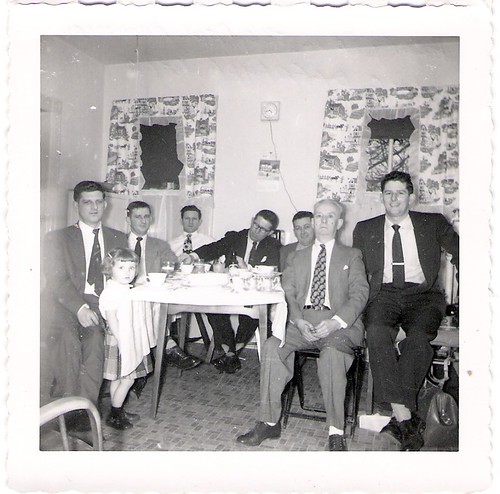
For at least one family gathering, the men sat around the kitchen table. In order left to right are Henry, Paul, Ted,  Paul Brousseau (married to Angela), Vin Campbell (married to Fran), Dad Sherlock, and Jerry.

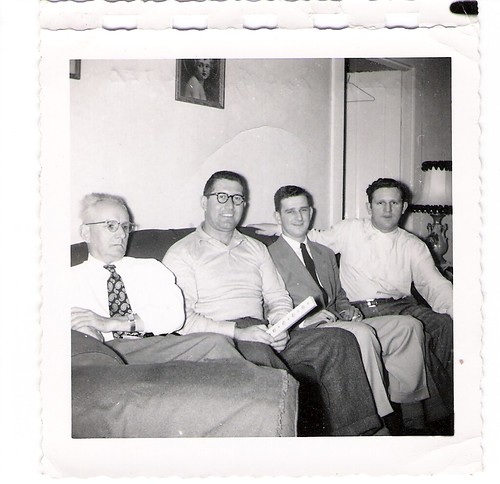
Maybe later the same day, this time along a couch: Dad Sherlock, Paul B, Paul, and Ted

How is it the same day? Dad Sherlock has the same time, Paul has the same suit/tie combo. Paul B took off his tie, and so has Ted. Both were known to like to relax that way.

Friday, March 26, 2010

Martina and Jerry

While eating with Martina and Jerry they spoke about getting permission to get into the war effort.
Jerry said that his parents refused to give him permission to join. " Ma said NO"
Martina then related the same thing." Oh, Ma refused to give me permission to go as a nurse."
She turned to me with the trademark Sherlock grin. I appealed to her as a mother. "But Ma if all the mothers of nurses told their daughters no, what would happen? Who would take care of all the boys? What would happen to Jack, Ted and Jerry?" Talk about your Irish guilt!

Mrs. Sherlock relented. Martina did add; " Well I didn't need permission as I was old enough. Times were different though I needed my mothers permission."

Jerry then said that he told the recruiter that his mother wouldn't give permission. The recruiter told Jerry that the Government would be drafting in September of 1943 and you never knew what would happen. She relented and Jerry was accepted for the Marines and went to Parris Island Recruit Depot in October of 1943. I suspect it was a little more complicated then that.

I am reminded after taking Jerry to see "Saving Private Ryan" I spoke to Jerry the next day and we spoke of some things that remain personal. However the one thing that stands out is like the fictional Mrs. Ryan, Jerry said Mrs. Sherlock had a banner with stars for Martin, Jack, Ted, Henry and Jerry. He said it must have been pretty hard on his mother. He considers himself very fortunate. Large families separated with members all over the world defending freedom. They all came home.

We tend to forget in our iPhone, Blackberry driven world of instant communications and take a lot for granted. Jerry and Martina spoke of getting mail from home. Times were different.

So the next time you voice or memory dial, take a moment to think of Mrs Sherlock in the dark days of the War with her children in far flung places. Never knowing.

Have a great day! Thanks Martina, Jack, Ted, Henry, Jerry, Fran, and of course Vin Campbell.

Paul

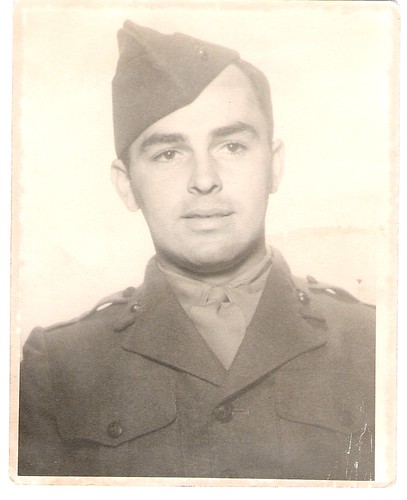
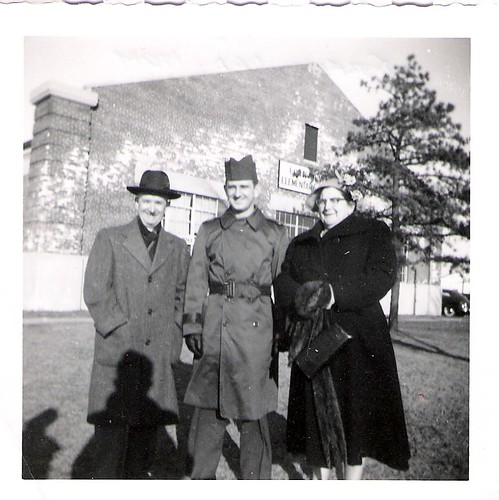
How close alike did the Sherlock men look? Close enough that Jerry had identified the man in the center of this photo as himself. Yet, upon further review, other family members are agreeing it is Jerry's brother Paul posing with their father and mother.


Clues to how this was really determined? The uniform cap was Army not Marine. Paul was in the Army, Jerry in the Marines.

The building behind is apparently named the Fort Devens Elementary School. Family members agree that Mr and Mrs Sherlock did visit Paul up at Fort Devens before he was sent overseas to Paris.